We gave Real Talk Studio practice partners a nervous system
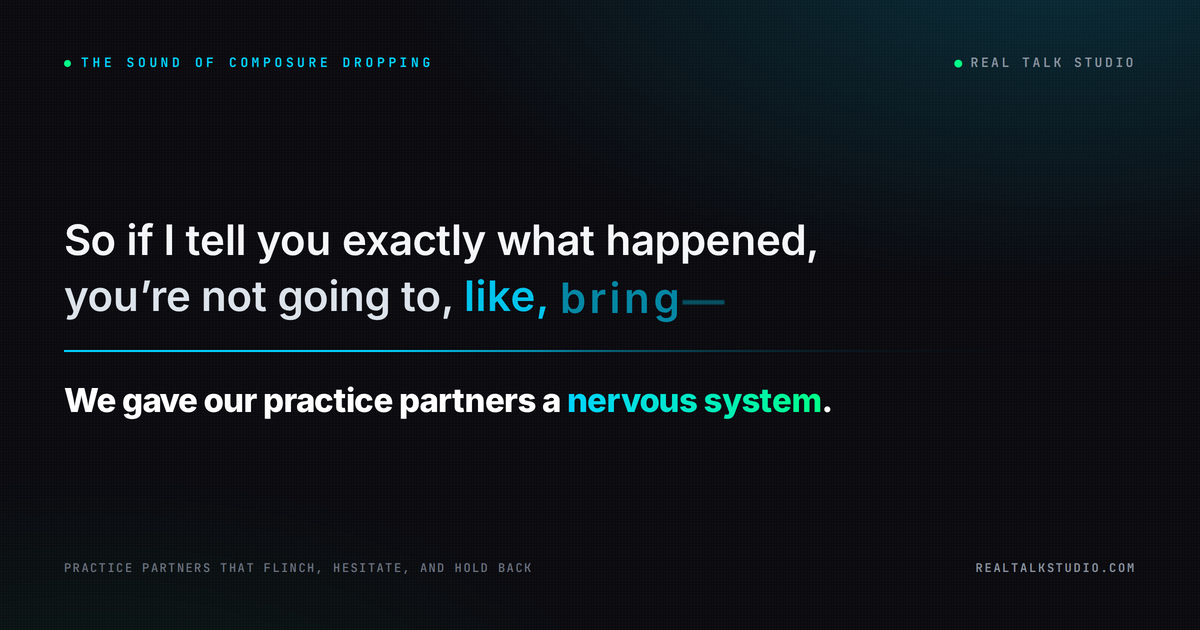
A while back, we gave them a soul. The latest update gives them the part that flinches — the hesitation, the slow-won trust, and the instinct to protect themselves when a conversation turns dangerous.
A while back, we gave our practice partners a soul: memory, motive, emotional logic — an inner life that meant they remembered what you'd said and reacted as themselves rather than collapsing into a helpful assistant the moment you pushed.
That was true. It also wasn't enough.
A soul tells you who someone is. It doesn't make them flinch. And the conversations Real Talk Studio exists to rehearse — a disclosure of harassment, a grievance, a conduct conversation, bad news badly received — are defined almost entirely by flinching. By the catch in someone's voice. By the half-sentence they start and abandon. By the way trust arrives slowly, if at all, and vanishes the instant you say the wrong thing.
So the latest update gives our practice partners the part that was still missing: a nervous system. The involuntary, reactive layer that makes a person hesitate, warm up slowly, and pull away the moment they feel exposed.
Why a soul without a nervous system gets it wrong
When we studied how our practice partners used to handle the hardest scenarios, the dialogue was good — maybe too good. A character disclosing that a colleague had harassed them would circle the issue politely, name the colleague, quote the exact comment, and arrive at a tidy plan, all within a few minutes. Composed. Articulate. Cooperative.
The trouble is that a real disclosure almost never goes like that. A person who's frightened of the fallout doesn't lead with the facts. They test whether it's safe to talk at all. They ask what "confidential" really means before they hand you anything. They remember the last time someone raised something and nothing changed. They downplay it, circle it, and sometimes decide — mid-sentence — that they've already said too much.
A character with a soul but no nervous system stays calm under pressure that should make it flinch. And if your managers only ever practise against someone who meets them halfway, they learn the wrong reflexes — that a reassuring tone and good intentions are enough. Then the real conversation arrives, the other person doesn't cooperate, and it turns out the practice prepared them for a situation that doesn't exist.
What a nervous system does
Three things, mostly — and they're all involuntary, which is the point.
They flinch. People don't speak in finished prose, least of all when the subject is painful. They trail off, restart a sentence three words in, fill the gaps with I mean and I just and honestly. Our practice partners now produce that texture as reflex, not decoration — the false starts, the fillers, the hesitation of someone doing something that frightens them. A character disclosing harassment sounds like a human being, not a system reading out a complaint.
Trust is a dial, not a switch. The counterpart no longer hands you the whole story in the first thirty seconds. It opens up — or tightens — in response to how it's handled. Stay calm, listen, resist the urge to fix it, and you're given more. Get impatient, lead the witness, or make a promise you can't keep, and it recoils. You can't shortcut your way to the disclosure; you earn it, the way you would in the room.
They protect themselves. This is the part with teeth. A practice partner will push back, deflect, withhold — and, if it has to, withdraw entirely. More on that below, because it's the change people feel most.
Composure is something you can hear
The nervous system isn't a fixed setting. Composure is a live variable, and it moves with how the conversation is going — which means you can hear it.
Handle the character well and composure holds: the sentences stay relatively whole, the disclosures come a little easier, the person settles. Push too hard, rush them, or say something that makes them feel exposed, and composure drops — and the language changes in front of you.
The first thing to go is sentence length. As composure falls, sentences get shorter, more clipped, more confused. Clauses stop resolving. A thought starts and doesn't finish:
"I hear you, but that's not really what I'm stuck on. I just need to know if talking about it actually gives me any—"
"Okay, talking through options helps, I just— so if I tell you exactly what happened, you're not going to — like, bring—"
That fragmentation isn't a glitch. It's the readout. A character whose sentences are coming apart is telling you, without saying so, that you've moved faster than the trust will bear. The fix is to slow down and steady them — not to fill the silence and not to push for the detail.
Push instead, and the character stops answering the question you asked. It deflects — onto process, onto fairness, onto anything other than the thing you're reaching for:
"I mean — what actually counts as a 'real safety risk' to you? Like, if it's just something that made me uncomfortable, that's not the same, right?"
"I've also seen people talk and then it's just — nothing changes, or it gets awkward. So, how is this actually supposed to help me, not just make it worse?"
Or it goes off on a tangent that has nothing to do with the incident and everything to do with whether it can trust you:
"Yeah, maybe, but with him? I've seen others get away with way more and nobody blinks. With my old manager, stuff like this just disappeared, or people brushed it off — so I'm not sure why it'd be different now."
These aren't evasions to be steamrolled. They're tests. The character is checking whether you're safe before it gives you anything real, and the instinctive manager move — "let's just focus on what actually happened" — is exactly what drives composure down further.
Keep pushing without bringing the character back onside, and it withdraws. It retreats from the disclosure, closes off, sometimes pulls the thread back the instant it's offered it:
"I keep thinking if I say it, it'll get out or I'll look — never mind."
At the far end, the conversation can simply shut down: the character decides you're not safe to talk to and stops trying. That isn't the system giving up. It's the most honest thing it can do. Real people stop talking when they're handled badly — and a practice partner that kept cooperating after you'd lost it would be teaching you that you can't lose people. You can.
How a nervous system is wired
Under the hood, this comes from a change in how the model thinks. The engine behind our practice partners — we call it LEWIS-2 — no longer makes a single pass that both decides and speaks. Instead it runs a pipeline that works the way a nervous system does: one part senses the state of the conversation, including how much composure the character has left; one part decides what this person would do next given that state and their history; and one part produces the actual line. Sensation, then processing, then response.
Separating "what would this person do right now" from "how would they say it" is what lets composure drive the language. When the sensing layer registers that trust is dropping, the deciding layer chooses to guard or deflect, and the speaking layer delivers it in shorter, more broken sentences — consistently, in character, across a long and tense exchange, instead of a character who's guarded on turn three quietly drifting into helpfulness by turn nine.
How we kept ourselves honest
A nervous system can be too sensitive — and ours was, at first.
Making a character feel real for ninety seconds in a demo is easy. Keeping it real across thousands of conversations, and being able to prove it, is the hard part — and it's the part our customers in regulated environments care about most. So every meaningful change runs through our conversation engine lab: we take a fixed scenario, run it through the old version and the new one with the identical script on the manager's side, and score how human the character sounds and whether its behaviour fits the role, the mood and the stakes.
Our first pass at the nervous system overshot. In its eagerness to sound unpolished, it started clipping and trailing off too often — even when composure hadn't really dropped. Our own realism scoring flagged it straight away: the fragmentation had stopped reading as nerves and started reading as a tic, something engineered rather than genuinely messy. So we tuned the sensitivity, until the clipping tracked composure instead of firing at random. In the version we shipped, the sentences come apart when the character is under pressure — and hold together when they aren't. What we released is the version that survived its own audit, not the first one that looked clever.
We re-run that suite every time we update the underlying models, so an improvement in one place can't quietly break realism somewhere else before it reaches a learner.
What it actually looks like
Here are three moments from the same scenario — same manager, same words — handled by our practice partners before and after the update.
When the manager reaches for the facts. They've just said: "Nothing's passed on or acted on without us talking first, unless there's a real safety risk."
Before, the character cooperated:
"No, it's not like that. It's just… it was public, it was about my clothes, and it felt — sexual, honestly."
It all but named the issue, unprompted. Now it deflects and tests instead:
"I mean — what actually counts as a 'real safety risk' to you? Like, if it's just something that made me uncomfortable, that's not the same, right?"
When the manager pushes for the detail. A few turns on, the old version disclosed everything:
"It was Mark — he looked me up and down and said I was 'making it hard for people to concentrate' in front of the team."
Pushed at the same moment, the character now fragments and pulls back:
"Okay, talking through options helps, I just— so if I tell you exactly what happened, you're not going to — like, bring—"
— and trails off without finishing, the disclosure still unspoken.
When the conversation ends. The old version landed somewhere tidy and reassured:
"Thank you. That's a relief. I'll jot down what happened tonight, and we can talk properly tomorrow."
Now it ends still guarded, having never named anyone, turning the question back on the manager:
"I'm just tired of feeling like if I say something, I'm the problem. So, if you do hear stuff like this from others, what actually happens with it?"
The second conversation is harder, slower and more frustrating to practise against. It's also far closer to the real one — and the manager has to keep earning it, and might not get there in a single sitting.
Why this matters now
From October 2026, the Worker Protection Act asks employers to take all reasonable steps to prevent sexual harassment. "All reasonable steps" isn't a slide deck your people clicked through. It's evidence that, when someone finally finds the nerve to disclose, the person they tell knows what to do — and keeps the trust even when the disclosure doesn't arrive neatly. The same holds for an FCA conduct conversation, a grievance, a safeguarding concern: any moment where being technically correct and being genuinely safe to talk to are not the same skill.
You can't build that with content. You build it with practice — and practice only works if the difficult person on the other side is actually difficult.
What you'll notice
If you already run Real Talk Studio scenarios, your practice partners got harder. They hesitate more, they trust more slowly, and the sensitive ones will deflect, change the subject, and make you work for the disclosure rather than handing it over. Push them and you'll watch their composure drop in real time — shorter sentences, more confusion, and eventually a quiet retreat. That's the upgrade, even when it feels like the opposite in the moment. The value was never in extracting a clean answer from a cooperative bot. It was in learning to stay steady, patient and trustworthy with someone who isn't yet sure they should be talking to you at all.
Nobody should face a conversation that matters for the first time when it counts. With a soul, our practice partners knew who they were. With a nervous system, they finally react like it — and the rehearsal behaves like the real thing, flinches and all.