The Employee Handbook is Dead: Fixing HR Compliance with AI and Interactive Roleplay

For the better part of a century, the employee handbook has been the "north star" of corporate governance. It is the document intended to codify culture, ensure workplace safety, and protect the organisation from liability.
But in 2024, that star has burned out.
A recent comprehensive analysis reveals a systemic crisis in HR policy management. The primary mechanism for regulating employee conduct is failing. The statistics are stark: 60% of employees admit to never reading their employee handbooks.
This isn't just an administrative annoyance; it is a major compliance risk. With major corporations producing manuals exceeding 40 sections and 75% of small businesses failing to update their documents despite rapid legislative changes, we have created a "compliance fiction." We pretend the rules are understood, while the workforce operates on rumor and "folk compliance."
Here is why traditional compliance training has collapsed, and how AI in HR—from chatbots to real-time avatars—is building a new bridge for the future.
The Cost of Non-Compliance: Fines and Efficiency Drains
When policies go unread, the costs are immediate and staggering. In 2024 alone, global fines for non-compliance reached $14 billion. Regulatory bodies are intensifying scrutiny on everything from wage transparency to data privacy, and a handbook that hasn't been updated since 2020 is effectively a "legal smoking gun" in the eyes of a court.
However, the financial drain isn't limited to fines. There is a hidden "Manager Tax" actively draining HR efficiency:
- 15 Hours/Week: The amount of time HR managers spend answering repetitive questions and fixing minor compliance errors.
- $12,506: The estimated annual productivity loss per employee spent "hunting" for scattered policy information.
Safety and Inequality: The Hidden Risks of Static HR Policies
The failure of policy communication is not felt equally across the workforce. Vague policies and static, "one-size-fits-all" training exacerbate existing inequalities and safety risks.
- Workplace Safety Criticality: In industrial and healthcare sectors, the "unread handbook" is a matter of life and death. Despite rigorous safety manuals, up to 90% of workplace accidents are attributed to human error—often stemming from a lack of procedural knowledge rather than malice.
- DEI and Policy Ambiguity: When promotion criteria or flexible work policies are opaque, marginalized groups suffer disproportionately. For instance, 95% of women believe utilizing flexible work policies—even when officially sanctioned in the handbook—will harm their career progression.
The AI Pivot: Using Generative AI to Modernize HR Policy
The corporate world is at an inflection point. The integration of Generative AI is shifting the paradigm from "compliance as a destination" to "compliance in the flow of work."
Instead of forcing a new hire to search a 50-page PDF for "bereavement leave," they simply ask an AI-powered HR chatbot: "How many days off do I get for a grandparent's funeral?" Early adopters of this technology are already seeing a 65% reduction in HR helpdesk queries.
But answering questions is just the baseline. The real revolution lies in interactive compliance training.
Interactive Compliance Training: Bringing Policies to Life with AI Avatars
Policies are often emotional. A PDF can explain the rules of bereavement leave, but it cannot teach a manager how to have the conversation about it. This is where AI real-time avatars are transforming compliance from a passive reading exercise into an active behavioral skill.
The "Flight Simulator" for Difficult Conversations New platforms allow managers and employees to practice high-stakes interactions in a safe, judgment-free environment. This is essential for soft skills training in the modern workplace.
- Simulation Training for Managers: Imagine a manager needs to explain the bereavement policy to a grieving employee. Instead of just quoting the handbook, they can practice the conversation with an AI avatar. The avatar reacts to their tone and choice of words, allowing the manager to practice responding compliantly (sticking to the rules) and compassionately (showing empathy).
- Reducing Anxiety: 75% of employees report feeling anxious about difficult workplace conversations. Practicing with an avatar reduces this anxiety, building the muscle memory to handle the real thing correctly.
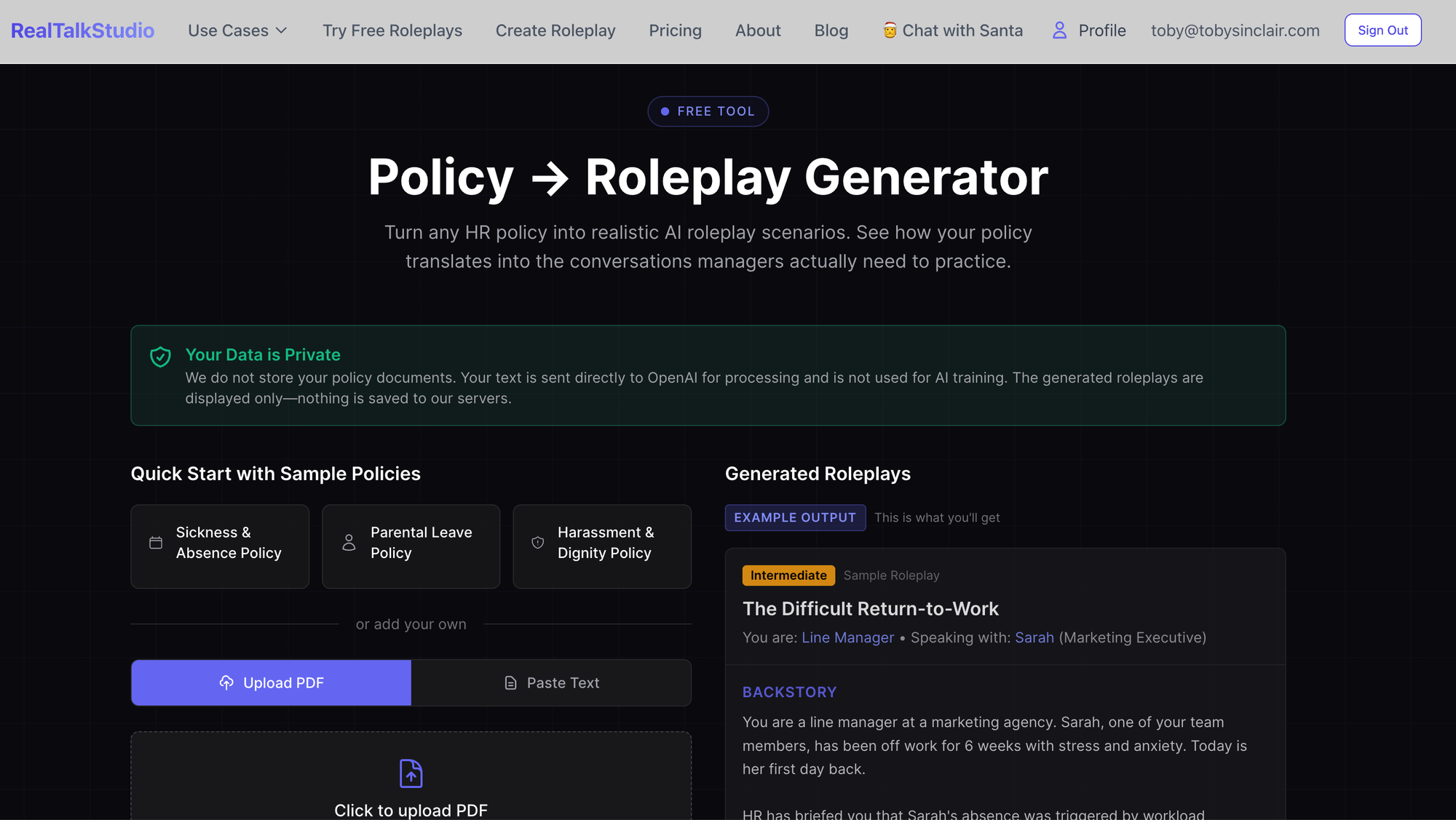
Real Talk Studio: Your Policy, Animated
Leading the charge in this space is Real Talk Studio, which allows you to bring your static policy documents to life with AI video roleplay. The process bypasses the need for expensive video production or actors.
- You simply upload a policy document or provide a snippet of text.
- The AI instantly generates a roleplay scenario based on that text.
- Your workforce gets to see the policy in action, rather than just reading about it.
The Trust Paradox: Why Employees Prefer AI for Sensitive Inquiries
Perhaps the most counter-intuitive finding in the 2024 research is the "Trust Inversion." As employees lose faith in the neutrality of human management, they are turning to machines for employee relations.
54% of business professionals report trusting AI more than human HR professionals for sensitive inquiries.
Why? Because an AI doesn't judge. An employee struggling with addiction might be terrified to ask a human manager about rehab leave policies for fear of stigmatization. A chatbot or avatar provides a "psychological safety zone" where they can access critical rights and benefits without social penalty.
Mitigating Risk: Hallucinations and RAG in HR Tech
While the potential is immense, the transition is not without peril. We cannot blindly hand over governance to algorithms. The disaster of New York City’s "MyCity" chatbot serves as a necessary warning. The bot, intended to help business owners, "hallucinated" illegal advice, telling landlords they could discriminate based on income source.
This highlights the need for Retrieval-Augmented Generation (RAG) in HR technology. The AI must be constrained to reason only from the company's verified internal data, citing specific pages of the handbook, rather than improvising based on the open internet.
Conclusion
For the modern enterprise, the choice is clear: cling to the "unread handbook" and risk liability, or build the bridge to a transparent, compliant future. By moving from static text to dynamic, avatar-based interactive training, HR leaders can finally close the gap between written policy and human practice.
Modernise Your HR Policies Today
Don't let your critical governance documents gather dust. You can try this technology immediately with Real Talk Studio. Simply upload a policy snippet, and the AI will create a custom video roleplay for you—showing you exactly how your policy sounds in the real world.